Ant infestations across Oklahoma City present distinct structural challenges driven by local geology and architectural styles. Properties in historic neighborhoods like Heritage Hills, Mesta Park, and Crown Heights…
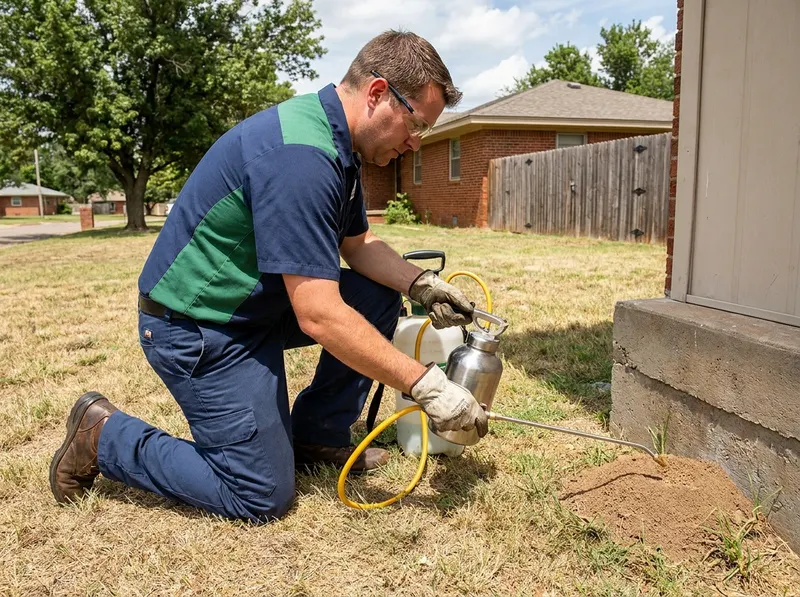
Ant infestations across Oklahoma City present distinct structural challenges driven by local geology and architectural styles. Properties in historic neighborhoods like Heritage Hills, Mesta Park, and Crown Heights frequently feature balloon-frame architecture and aged native timber, creating ideal moisture gradients for Camponotus pennsylvanicus (black carpenter ants). Farther north along the Nichols Hills Suburban Edge and Quail Springs, expansive Permian red clay soils contract during hot summer dry spells, pulling away from concrete slab foundations. This structural separation establishes subterranean highways directly into wall voids for Tapinoma sessile (odorous house ants) and Tetramorium immigrans (pavement ants). Typical retail pyrethroid contact sprays trigger bud-nesting behaviors, causing polygyne (multi-queen) colonies to fracture and scatter satellite nests deeper into insulation and kitchen subfloors.
Effective ant colony suppression depends on horizontal transfer chemistry rather than localized mortality. Technicians deploy slow-acting, non-repellent formulations containing active ingredients such as fipronil or dinotefuran paired with specific carbohydrate- or protein-based bait matrices calibrated to the colony's current reproductive cycle. Foraging worker ants traverse the micro-barrier without detecting the chemistry, subsequently distributing the compound throughout the entire gallery network via trophallaxis (food sharing) and mutual grooming. In dense historical pockets like The Paseo Arts District, Plaza District, and Capitol Hill, where exterior stone foundations meet perimeter turf, this method prevents the disruption of the queen's chamber, ensuring the complete cessation of reproductive egg-laying without requiring intrusive structural demolition.
Property owners evaluating remediation options face a fundamental trade-off between broad-spectrum exterior barrier sprays and targeted entomological suppression. High-volume perimeter spraying temporarily deters perimeter invaders around patios near Scissortail Park or Midtown lofts, but it fails to address colonies established beneath interior subflooring or within plumbing chases. Conversely, target-specific suppression demands 7 to 14 days for the non-repellent chemistry to circulate through the worker population to the reproductive core, yet it eliminates recurring rebound cycles and minimizes chemical volume inside living spaces.
Every job gets a firm, written price after a free on-site visit.
Tell us about your ant colony suppression job in Oklahoma City and we'll send a clear, written quote, usually the same day.
 Zorevia Insect Specialists