Commensal rodent control requires addressing both the interior breeding colony and exterior architectural breaches. In historic Oklahoma City neighborhoods such as Mesta Park, Heritage Hills, and Crown Heights, homes…
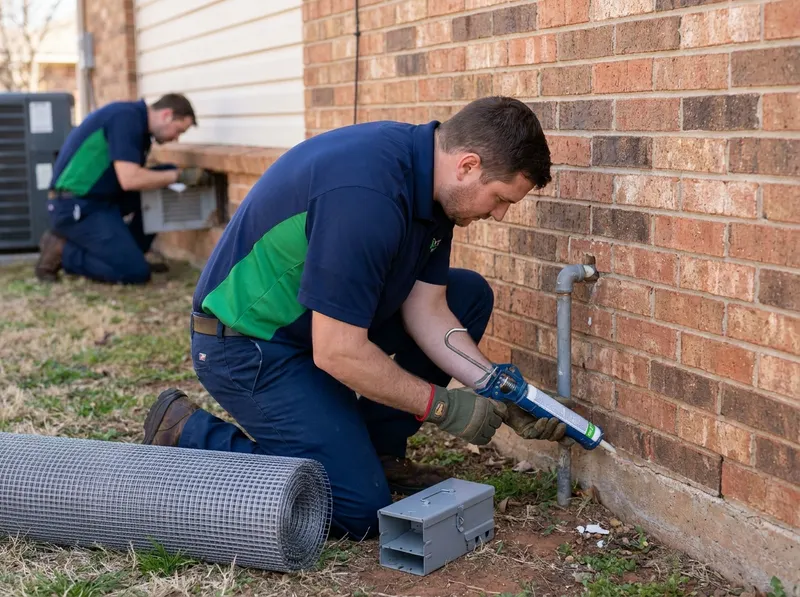
Commensal rodent control requires addressing both the interior breeding colony and exterior architectural breaches. In historic Oklahoma City neighborhoods such as Mesta Park, Heritage Hills, and Crown Heights, homes constructed with native sandstone footings and aging lumber frequently present ground-level foundation cracks and unshielded crawlspace vents. Mus musculus requires a breach of only one-quarter inch to enter living quarters, while Rattus norvegicus utilizes gaps of one-half inch along plumbing chases or pier-and-beam floorings. Chemical bait stations placed outdoors only address incidental foraging populations; without rigid physical exclusion, new colonies track pheromone trails directly back into wall voids. Structural exclusion seals these entryways using heavy 18-gauge 1/4-inch galvanized hardware cloth, copper mesh, and metal-reinforced polyurethane elastomeric sealants that withstand persistent gnawing.
Roof rat activity increases dramatically in heavily canopied sectors like Nichols Hills Suburban Edge, Quail Springs, and The Paseo Arts District, where mature post oaks, elms, and utility drops touch rooflines. Rattus rattus exploits unsealed ridge-cap voids, soffit vents, and attic dormer flashing, establishing elevated nesting galleries above the ceiling insulation. Trapping runs concurrently with physical sealing to catch animals inside the envelope. Snaptraps and mechanical capture boxes are positioned precisely along established runs, rafters, and baseboards within attics, basements, and subfloors rather than randomly inside food-prep areas. Step one establishes structural containment by sealing high and low ingress points. Step two deploys directional, non-toxic traps along wall-stud travel paths. Step three monitors trap lines every 48 to 72 hours until zero activity is recorded over seven consecutive days. Step four clears carcasses and conducts localized surface sanitization of nesting zones to remove allergens, mites, and microbial contaminants.
Trade-offs exist between chemical rodenticide broadcasts and mechanical trapping coupled with exclusion. Broadcast baits can leave carcasses decomposing within interior wall cavities, creating secondary carpet beetle and blowfly infestations alongside lingering odors. Mechanical exclusion and focused trap arrays isolate extraction entirely, preventing domestic pets and local wildlife near Lake Hefner or the Myriad Botanical Gardens from suffering secondary poisoning via anticoagulants. Properties situated near mixed-use retail corridors, such as Midtown, Deep Deuce, Capitol Hill, or the Plaza District, face constant surrounding pest pressure from dumpster corrals. For these sites, sealing perimeter pipe penetrations, weep screeds, and HVAC chase runs creates a standalone physical envelope that remains impenetrable regardless of regional rodent density.
Every job gets a firm, written price after a free on-site visit.
Tell us about your rodent exclusion and trapping job in Oklahoma City and we'll send a clear, written quote, usually the same day.
 Zorevia Insect Specialists