Flea and tick structural defense in Oklahoma City targets the biological vulnerability of parasitic arachnids and siphonaptera before established breeding colonies cause health risks. Oklahoma County experiences…
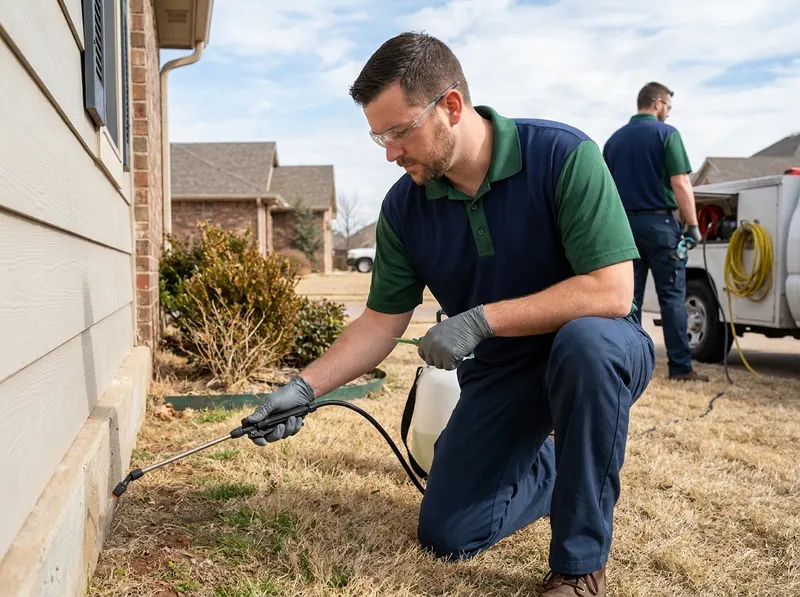
Flea and tick structural defense in Oklahoma City targets the biological vulnerability of parasitic arachnids and siphonaptera before established breeding colonies cause health risks. Oklahoma County experiences sustained relative humidity alongside extended 90-degree summer spans, conditions that compress flea gestation to roughly 14 days and accelerate tick questing behavior near residential structures. Standard over-the-counter surface aerosols fail because 95 percent of an active flea population exists not as adults, but as eggs, larvae, and pupae protected deep inside subflooring, area rugs, and baseboard junctions. Structural defense interrupts this developmental cascade through juvenile hormone mimics, preventing pupal emergence while perimeter residuals stop outdoor questing ticks at the foundation edge.
Treatment selection balances localized interior infestation against continuous exterior pressure. For interior flea breakouts, applying an adulticide paired with an insect growth regulator (IGR) like pyriproxyfen renders female fleas sterile within 24 hours and stops larval development for up to 210 days. When property owners face tick migration without an established indoor flea population, an exterior structural barrier of microencapsulated bifenthrin applied 3 feet up the exterior masonry and 5 feet outward along the soil line provides perimeter protection without interior pesticide placement. Properties bordering dense ground cover or native timber require dual-zone intervention to prevent tick transport via wild fauna, accepting the operational trade-off of temporary vacating periods during interior drying.
Specific architectural styles throughout Oklahoma City dictate targeted application procedures. Historic residences in Heritage Hills, Mesta Park, and Crown Heights frequently feature raised pier-and-beam foundations and tongue-and-groove hardwood floors. These structural voids retain crawlspace humidity that harbors flea larvae away from dry living areas, requiring sub-floor void calibration. Conversely, slab-on-grade builds common in Quail Springs and the Nichols Hills Suburban Edge direct focus toward weep holes, expansion joints, and perimeter turf transitions where brown dog ticks crawl vertically up exterior brickwork. Urban residences across Midtown, Deep Deuce, the Plaza District, Capitol Hill, and The Paseo Arts District often feature compact turf footprints with microclimates created by privacy fencing, where adult ticks quest on low-lying vegetation adjacent to covered patios.
Preparation directly governs structural efficacy. Successful remediation requires complete vacuuming of floor areas, laundering pet bedding at 140 degrees Fahrenheit, and vacating occupants and domestic pets for 2 to 4 hours until aqueous solutions dry. A single application halts active questing; however, mechanical stimulation from continued foot traffic over the subsequent 14 days is necessary to force viable pupae from their protective silk cocoons to contact the resting residual deposit.
Every job gets a firm, written price after a free on-site visit.
Tell us about your flea and tick structural defense job in Oklahoma City and we'll send a clear, written quote, usually the same day.
 Zorevia Insect Specialists