Subterranean termites require continuous contact with soil moisture to survive, constructing earthen shelter tubes over masonry footings to access structural sill plates, floor joists, and wall studs. In Oklahoma City,…
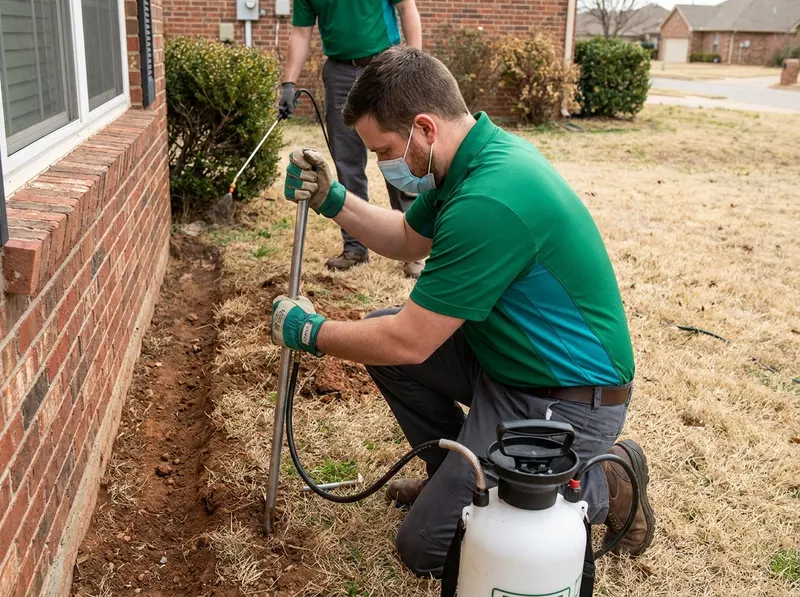
Subterranean termites require continuous contact with soil moisture to survive, constructing earthen shelter tubes over masonry footings to access structural sill plates, floor joists, and wall studs. In Oklahoma City, properties near moist riparian zones such as Lake Milton State Park, Berlin Reservoir, and the Meander Creek Reservoir face heightened pressure from subterranean colonies nesting deep within damp clay-loam subsoils. Remediation relies on creating an uninterrupted chemical barrier around the building envelope. Technicians excavate a shallow 6-inch by 6-inch trench immediately adjacent to foundation walls, saturating the backfill with non-repellent liquid termiticides such as fipronil or imidacloprid at label rates of 4 gallons per 10 linear feet. For structures built on monolithic or floating concrete slabs, specialized rotary hammer drills penetrate the perimeter slab every 10 to 12 inches to inject protective material directly into the aggregate base beneath the floor.
Selecting between continuous liquid barrier applications and slow-acting baiting systems depends on structural design and site hydrology. Monolithic slabs and crawlspace foundations in the Western Reserve West and Maple Ridge subdivisions benefit from continuous liquid barriers, which eradicate foraging workers as they pass through treated substrate and transfer the active ingredient back to the central queen via mutual grooming. Conversely, acreage parcels along the Snodes Corridor, Patmos Road Farmlands, and the Berlin Center Rural Outskirts frequently feature shallow water tables, private drinking wells, or sandstone outcroppings where sub-slab liquid injection is hydrogeologically restricted. In these settings, in-ground baiting stations installed at 10- to 20-foot intervals intercept foragers using insect growth regulators like noviflumuron, arresting the colony's molting process without risking groundwater contamination.
Property owners evaluating remediation options must balance application invasiveness against colony eradication speed. A direct liquid soil application creates an immediate structural exclusionary perimeter, neutralizing workers penetrating foundation cracks within 14 to 90 days, though it requires visible trenching in garden beds and discrete patching holes across finished garage aprons or patios. Monitored baiting grids preserve finished hardscapes and sensitive exterior plantings around historic sites like the Canfield Fairgrounds corridor, but rely on seasonal foraging patterns, typically requiring 3 to 9 months to achieve total colony collapse. In both approaches, addressing subterranean termites is distinct from superficial surface spraying; topical hardware-store aerosols eliminate visible swarming reproductives inside living spaces but leave subterranean worker populations intact behind drywall, where structural lumber consumption continues unchecked.
Every job gets a firm, written price after a free on-site visit.
Tell us about your subterranean termite treatment job in Oklahoma City and we'll send a clear, written quote, usually the same day.
 Zorevia Insect Specialists