Commercial food-service insect defense operates as a clinical protocol designed specifically for dining facilities, institutional kitchens, and processing spaces throughout Mahoning County. Standard perimeter chemical…
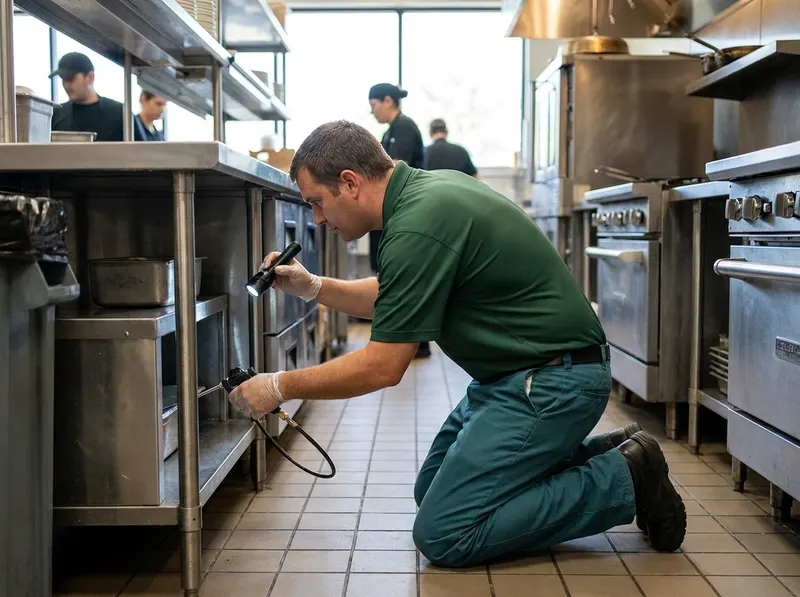
Commercial food-service insect defense operates as a clinical protocol designed specifically for dining facilities, institutional kitchens, and processing spaces throughout Mahoning County. Standard perimeter chemical applications fail in commercial kitchens due to elevated thermal output, high ambient humidity, and ambient grease films that degrade surface residuals within days. In commercial corridors along Western Reserve West and the Snodes Corridor, facilities require targeted micro-injection gel matrices and localized insect growth regulators that disrupt reproductive cycles without contacting active food-contact surfaces. The strategy separates treatment protocols into three operational zones: wet sanitation lines, prep table dead spaces, and cold-storage seals, ensuring insect harborage points are systematically neutralized.
Decision-fit considerations dictate clear facility parameters. A quarterly surface barrier spray does not resolve active commercial insect infestations; it scatters German cockroach populations deeper into motor housings, hollow stainless table legs, and hollow block structural voids. If a kitchen exhibits reproductive clusters behind cooking lines or larval development inside floor sinks, specialized micro-injection baiting combined with bio-enzymatic foam applications is required. While mechanical foam application demands rigorous nightly pre-cleaning by kitchen staff to strip competing food matter, it terminates biofilm harborage where larvae feed. For rural dining venues and processing sites near the Berlin Center Rural Outskirts and Patmos Road Farmlands, rodent-associated stored product pests often intersect with kitchen fly vectors, requiring integrated wall-void dusting and door-sweep physical barriers.
Execution follows an objective, sequential remediation sequence to halt escalating populations. First, the technician conducts a thermal and moisture assessment using focused borescope optics behind wall flashings and floor sinks to map exact nesting colonies. Second, technicians inject non-repellent formulations and juvenile hormone analogs directly into structural voids, motor assemblies, and pipe chases. Third, technicians apply high-expansion enzymatic foam into floor drains, grease trap cleanouts, and waste plumbing channels to digest biological fats that feed fly larvae. Fourth, monitoring stations with calibrated insect capture surfaces are mapped and logged to monitor colony decline across 14-day intervals. For service evaluation and initial inspection scheduling, contact (405) 212-1067.
Every job gets a firm, written price after a free on-site visit.
Tell us about your commercial food-service insect defense job in Oklahoma City and we'll send a clear, written quote, usually the same day.
 Zorevia Insect Specialists