Crawlspace encapsulation and wood-borer defense addresses the biological dependency of structural wood-boring insects on subterranean humidity. In structures situated near wet basins like the Meander Creek Reservoir or…
Crawlspace encapsulation and wood-borer defense addresses the biological dependency of structural wood-boring insects on subterranean humidity. In structures situated near wet basins like the Meander Creek Reservoir or Berlin Reservoir, soil dampness continuously evaporates upward into structural framing timbers. Subfloor wood moisture levels exceeding 18% create prime conditions for powderpost beetles and subterranean termites, which ingest damp cellulose and hollow out joists beneath primary subflooring. Applying hardware store aerosol sprays into a crawlspace access hatch fails to address this ingress mechanism; airborne treatments dissipate rapidly without penetrating timber grains or stopping the subterranean capillary draw of moisture.
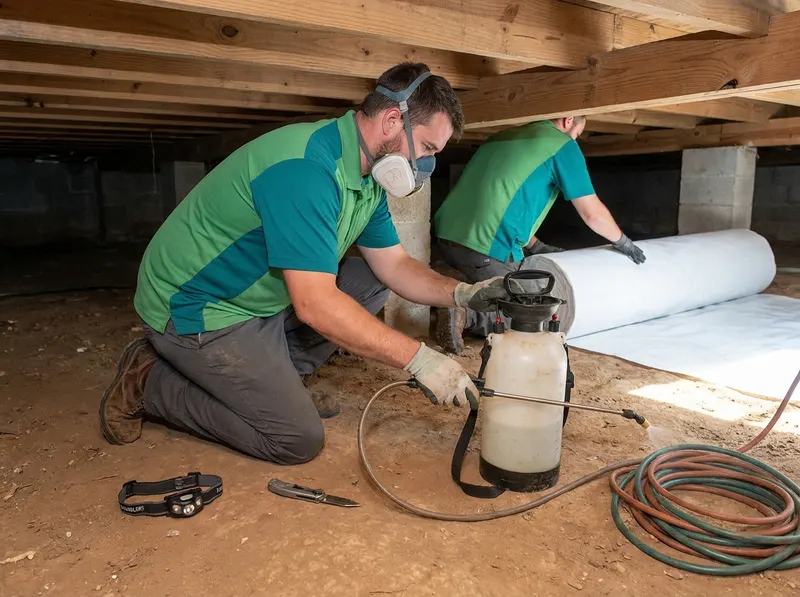
Encapsulation converts an open-vent crawlspace into a conditioned envelope. Technicians lay a continuous 12-mil or 20-mil cross-laminated polyethylene barrier across the crawlspace floor, overlapping seams by at least 12 inches and mechanically anchoring the edges to foundation stem walls with polyurethane adhesives and masonry fasteners. Foundation vents are sealed to prevent humid exterior air from entering during high dew-point summer cycles. Structural framing, including sill plates, joists, and subflooring, is sprayed or foamed with disodium octaborate tetrahydrate (DOT), which diffuses into the cellular wood matrix to provide a permanent insecticidal mineral salt layer that neutralizes borer larvae upon ingestion.
Property construction dictates whether targeted borate treatments or complete encapsulation is necessary. In historic crawlspaces throughout the Maple Ridge and Western Reserve West corridors, low ground clearance under 24 inches limits ductwork modification, making focused sill-plate chemical injection and ground-sheet laying the practical choice over complex mechanical dehumidifier setups. Conversely, wide-footprint farm properties along the Patmos Road Farmlands and Snodes Corridor require full perimeter sealing with commercial low-temperature dehumidification systems to arrest active joist degradation. The trade-off between partial ground sealing and full conditioned encapsulation centers on mechanical equipment maintenance: simple vapor barriers require zero electrical maintenance, whereas sealed envelopes with active dehumidification require annual condensate pump checks and filter replacements to prevent water accumulation near foundation footers.
Structural subflooring across the Benton Road Enclave and Berlin Center Rural Outskirts faces seasonal microclimates influenced by nearby agricultural run-off and proximity to Lake Milton State Park. Encapsulation procedures require an initial baseline moisture evaluation using deep-probe electrical pin meters before barrier installation. If subfloor timber moisture reads above 20%, mechanical drying must lower the moisture content below 16% prior to sealing, preventing trapped dampness from inducing fungal decay behind chemical insect barriers.
Every job gets a firm, written price after a free on-site visit.
Tell us about your crawlspace encapsulation & wood-borer defense job in Oklahoma City and we'll send a clear, written quote, usually the same day.
 Zorevia Insect Specialists