Zorevia Insect SpecialistsZorevia Insect Specialists

Flea & Tick Residual Remediation Oklahoma City

Flea and tick populations require precise biochemical control because non-prescription pyrethroid foggers fail to penetrate pupal cocoons or halt the larval molting process. Inside residential structures, flea larvae…
Get My Free Estimate →(405) 212-1067
Flea & Tick Residual Remediation in Oklahoma City, OH
Quick answer
  • What is included: Precision indoor micro-encapsulated adulticide application, an insect growth regulator (IGR) tank mix, and outdoor perimeter band treatment.
  • Turnaround time: On-site initial remediation takes 90 to 180 minutes; full biological disruption requires a 14-day pupal clearance window.
  • Baseline cost: Remediation packages begin at the $250 base minimum, scaling with square footage and yard perimeter acreage.
  • Targeted pests: Ctenocephalides felis (cat flea), Pulex irritans, Dermacentor variabilis (American dog tick), and Ixodes scapularis (blacklegged deer tick).
  • Intake protocol: Direct phone dispatch at (405) 212-1067 initiates clinical pre-treatment preparation instructions and property assessment.

Flea and tick populations require precise biochemical control because non-prescription pyrethroid foggers fail to penetrate pupal cocoons or halt the larval molting process. Inside residential structures, flea larvae burrow deep into carpet pile, baseboard crevices, and upholstery seams to feed on adult fecal blood. Flea & Tick Residual Remediation deploys an EPA-registered micro-encapsulated adulticide paired with an insect growth regulator such as pyriproxyfen. This biochemical tank mix arrests chitin synthesis, rendering emerged nymphs sterile and preventing reproductive completion. The physical trade-off of this protocol involves mandatory vacate windows: occupants and domestic pets must vacate treated structures for 2 to 4 hours until liquid barriers reach full structural drying.

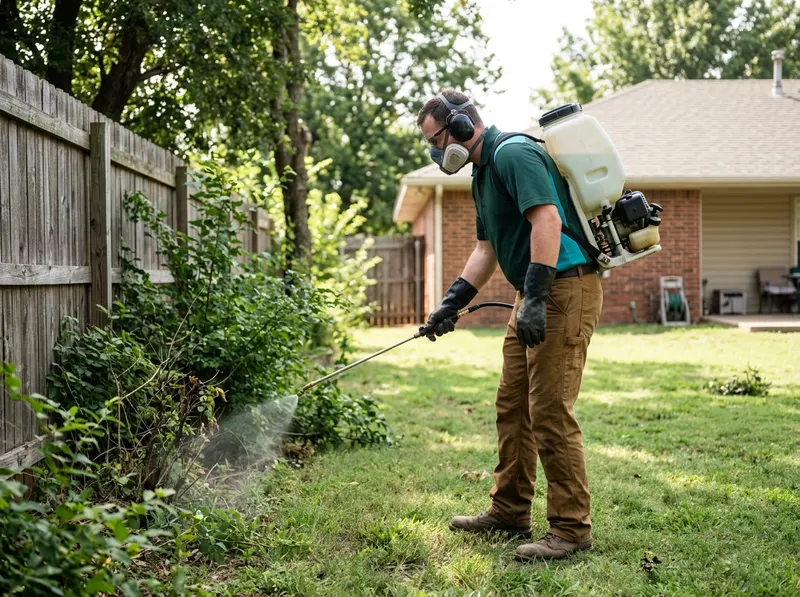
Outdoor treatment protocols address the specific ecotones found throughout Mahoning County. Properties along the Snodes Corridor, Patmos Road Farmlands, and the Berlin Center Rural Outskirts frequently interface with unmanaged brush, white-tailed deer pathways, and damp leaf litter. These microclimates foster heavy tick questing behaviors near turf transitions. Remediation requires establishing a continuous 20-foot barrier band using synthetic pyrethroids applied through dedicated hydraulic misting systems, targeting understory vegetation beneath 18 inches. In urbanized pockets like Maple Ridge, Western Reserve West, and the Benton Road Enclave, tick exposure remains concentrated along shaded fence lines, ornamental mulch beds, and concrete patio borders near Mill Creek MetroParks Bikeway corridors.

Targeted residual remediation differs fundamentally from broadcast carpet shampooing or over-the-counter flea dips. Topical pet treatments address host-bound adult parasites, but over 90 percent of an active infestation exists off-host as microscopic eggs, larvae, and pupae within flooring and soil. Residual remediation treats the structural substrate itself, maintaining active residue levels across 60 to 90 days. During days 7 through 14 post-treatment, pupae continue to emerge due to mechanical vibrations and carbon dioxide cues; these emerging adults absorb the active residue upon contact and expire before depositing viable eggs. Properties near damp riparian zones around Berlin Reservoir, Lake Milton State Park, and Meander Creek Reservoir require strict boundary monitoring to prevent exterior tick reintroduction during high-humidity summer peaks.

Flea & Tick Residual Remediation cost in Oklahoma City

Interior Treatment Under 1,500 Sq Ft (Base Minimum)$250 - $325
Standard Home Interior & Perimeter (1,500 - 2,500 Sq Ft)$325 - $450
Large Structure & Yard Perimeter up to 0.5 Acre$450 - $650
Acreage Turf Barrier & Woodline Misting (Per Acre)$275 - $400

Every job gets a firm, written price after a free on-site visit.

Common questions

How does weather affect flea and tick remediation in Oklahoma City?
Exterior residual remediation requires a minimum 2-hour dry window before rainfall to bond with foliage; high ambient humidity around Berlin Reservoir and Meander Creek Reservoir slows drying but does not diminish residual longevity once cured.
What preparation is mandatory before indoor application in Oklahoma City homes?
Flooring must be thoroughly vacuumed to stimulate pupal emergence, all pet bedding laundered at 140 degrees Fahrenheit, loose floor items cleared, and domestic animals removed from the premises for a baseline 3-hour period.
Why are fleas still visible after residual treatment in Oklahoma City?
The pupal cocoon protects developing fleas from all registered insecticides; newly developed adults must hatch and contact the residual surface, a normal biological progression that resolves within 14 to 21 days.
Are flea and tick residual chemicals safe around children and pets in Oklahoma City?
Once micro-encapsulated formulations completely dry onto surfaces, active ingredients bond to fibers and soil, presenting negligible transfer risk when applied strictly according to label specifications.
How many remediation visits are necessary to break the cycle in Oklahoma City?
A single targeted application containing an adulticide and an insect growth regulator resolves most infestations, though severe rural environments along the Canfield Fairgrounds perimeter may require a scheduled follow-up inspection at day 21.
Helpful resources

Trusted references & local links

USA.gov, government & consumer helpBetter Business BureauFTC Consumer AdviceU.S. Small Business AdministrationReady.govU.S. EPAENERGY STARU.S. Dept. of EnergyConsumer.govU.S. Census BureauGoogle Maps, Oklahoma City, OH

Get started today

Tell us about your flea & tick residual remediation job in Oklahoma City and we'll send a clear, written quote, usually the same day.

Get your free Pest Control Service quote, Oklahoma City

We only use your ZIP to check availability, no spam.